



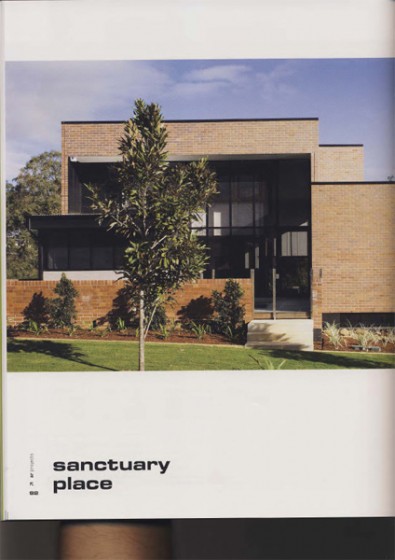
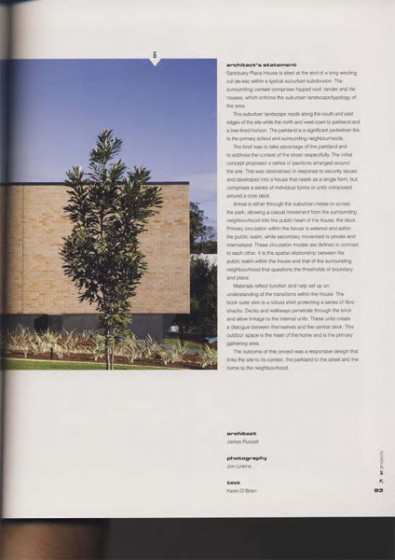
Sanctuary Place: Sep Yama / Finding Country 5 Ways
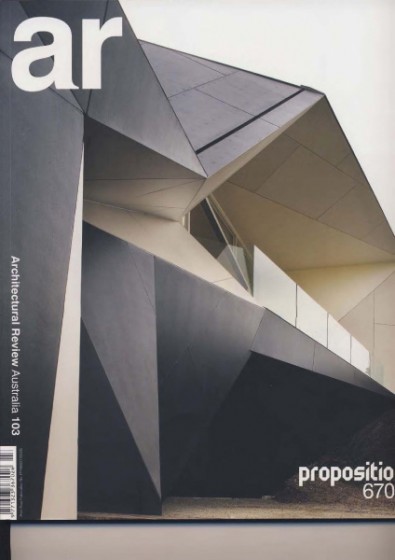
Architectural Review, Issue 103
November, 2007
Architect: James Russell Architect
Written: Kevin O'Brien
Intelligent architecture allows a generosity of reading. It does not expect that we follow the architect’s instructions but that one is allowed to breath their own meaning into it and take away their own memory. Here, on the fringe of a postured architectural mass of national thinking, is an architectural gem. Its purpose, as I see it, is simple: to make a “camp”. In so doing it has accidentally revealed a passion for Country. Not necessarily Country in the way I might define it but Country in at least how I might recognise it; something alive, something powerful to be engaged.
'Camp'
Camp is a potent word. It is both noun and verb.
As a noun, it protects a central ground. It can temporarily capture part of it. Nothing is permanent, everything dies at some point. The site is constrained by the surveyor’s pegs that measure the dollar value of the captured land. It is therefore not unreasonable to argue that a project reacting only to site is denying Country.
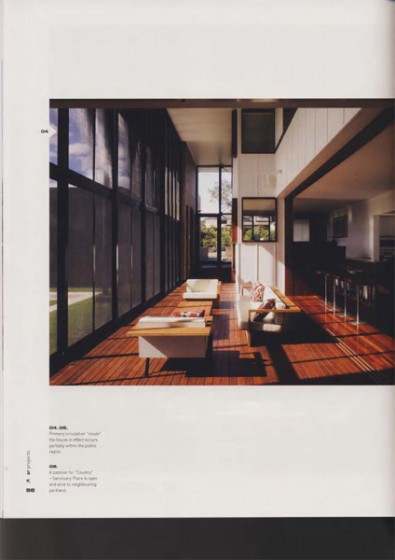
As a verb, it cooks to the open sky, it sleeps in a closed tent, it speaks under the shade (sometimes around a fire), it stares towards a prospect and feels ground under foot.
Considered together, it is a move that positions one in conversation with Country – a way into Dreaming.
'Plan'
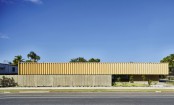
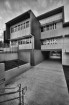
The surrounding development is comprised of distinctly middle class, security secured, form driven statements of pseudo wealth. It is not lifestyle that is protected rather material possession. Big houses on small sites all around, like bodybuilders packed into tight singlets. The condenser units snort, inhale and exhale. The denial of Country made easy.
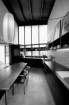
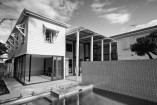
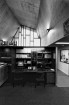
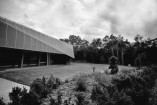
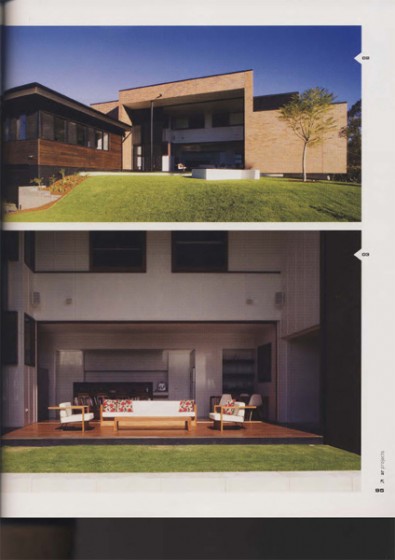
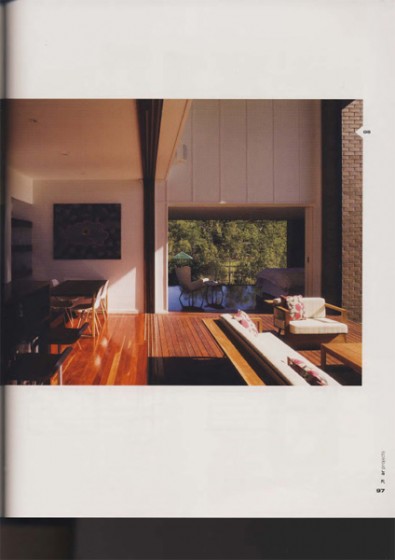
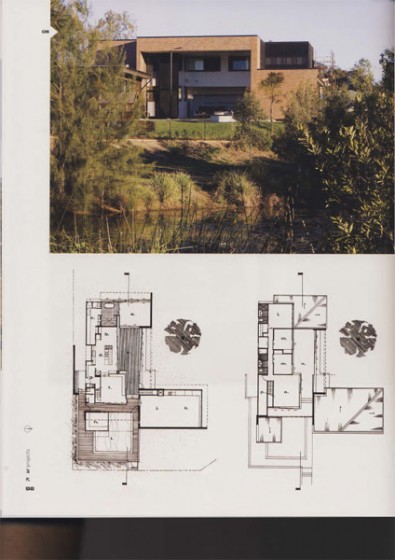
The kitchen is positioned in the centre of the plan, beside a dam, to a distant prospect framed by a monumental opening. At the centre of the camp is the cooking and eating in between the ground and sky. The first move revealed.
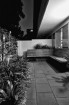
Here, sleeping is a womb like sequence experienced daily. From the ground it is a compressed upward movement, into darkness, to a nest like position that secures Dreaming. The second move revealed.
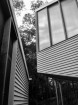
Liminal space is the heart here. The ambiguous space snaking around the rigid masonry elements supports life. It is the setting for the unexpected and the ephemeral. This is where the richness lies. A third move realized.
'Smelt'
This place, like a camp, is governed by that which is smelt. Every day, the primary external experience will detail memory of the season, the health of the dam, the death of the frogs, the breeding of the mosquitoes, the copulation of scrub turkeys, the tidal flow of the nearby muddy river. The horizon connected to the tap.
Capturing these sensory experiences is an overlooked purpose of architecture. A sense of memory established first through that which is smelt.
'Company'
A camp is subject to its company, ie those camping.
It requires the complicity of the architect, the builder and the client to achieve its anticipated standard of quality. James Russell, Lachlan Nielsen, Andrew Ryan, David King and Katrina King are the conspirators.
Every idea requires them. The integrity of the idea requires collusion and negotiation but is ultimately kept on course by a secure grasp on the dignity of the outcome.
For people, unlike architecture, it is not their finish but their spirit that ultimately ensures complicity for an idea from beginning to end. The spineless fabricate excuses and die in time with little to show.
'Alienation'
Continuing to cut the sacred relationship between man and the natural world is the ultimate crime.
Every part of Australia, of this Country, has a memory. Australian cities continue to expand blindly both out and up – no one looks down, into the ground, into Country. An expertise of expansion has been amassed and architects are not part of it. An architecture of Camping eases Alienation because it looks into the ground.
Here, on the fringe, is an idea played out, that is distinctly of this Country. An insurmountable well of possibility right here, only barely scratched ... right under where Oxley and Brisbane landed a little while back.
'The Argument'
The argument is that architecture is a potent mechanism that can allow us to find Country. It is not a technique as much as a way of thinking. The acknowledgement of this relationship and its impact on memory is what must be accepted here. This humble project embraces this very notion from where I sit, and this is why:
#1. Camping is an idea. Everyone gets it. It is the first way into finding Country.
#2. This house recalibrates liminal space as the central setting for life. This second way marries life’s rituals with Country, a partnership.
#3. Each Country has a smell. This third way is engaged simply through the monumental opening.
#4. For the idea to be successful (in this instance camping), it must be supported by its company. In the fourth way, if there is no complicity it becomes a tortured relationship and kills.
#5. Every built thing sits on Country. The choice is eyes wide shut to maintain the belief of an empty land or to find Country and connect to it. The fifth way is much more difficult, it has required that the architect turn into the foul wind of the surrounding estate. He has done this.
End.
