




Against the Grain
Monument (unpublished)
January, 2009
Architect : James Russell
Written: Kevin O’Brien
The Australian city is in crisis. The past decade of economic excess has, for the most part, smothered the idea that our capitals may enable dignified civic settings. It is sad that these settings have been denied the prompts that the timeless land they occupy inspire. The impotence of the urban form to engage Country continues to rob the citizen of a complete place-making identity. This primeval relationship emanates from the ground and manifests in two ways: spatial and material.
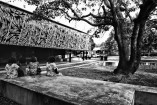
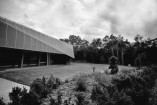
For the past six years, James Russell has been inhabiting and rethinking a site dominated by a 19th-century heritage-listed Methodist Church. The building became redundant when the Methodists, Presbyterians and the Congregational Union joined to form the Uniting Church of Australia in 1977. From that time, until James and Patricia Russell purchased the site in 2002, it lacked life. Today the site is bustling with energy, supporting their residence, a furniture showroom, coffee shop, an office, and a second residence. One can eat, sleep, work, play and love on this site. Most of it has been built by Russell and a select gang of friends and tradespeople. The architect’s philosophy informs an identity.
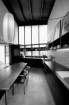
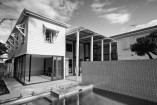
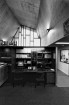
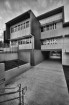
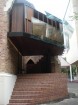
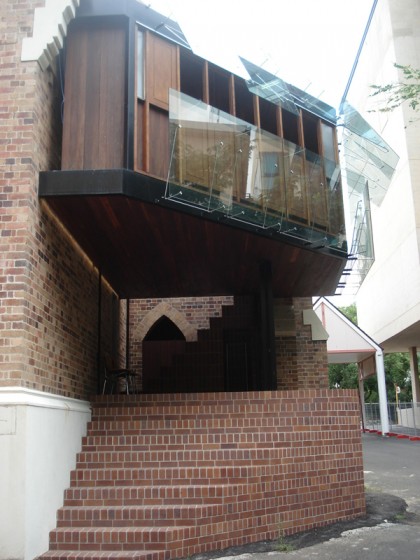
The office occupies the north-east external corner of the church, just beside the altar extrusion. It rises three levels in section and consists of three distinct spaces: a windowless cavern formed by brick, a horizontal void atop a plinth enclosed by glass and an upper wooden box with a hole to the sky. None are fully closed to the outside. All are detailed to get wet. It is a rejection of the conventional.
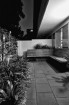
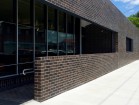
For more than 7000 years, fired brick has held a direct connection with the two natural elements of fire and earth. The application of brick to define the partially submerged lower space conveys a clear sense of the poetic. Internally, the archive room is accessed from a stainless-steel ladder hung from an intimate hole in the plinth. Externally, ziggurat-like steps ascend to the plinth, to the rear of which top-lit compressed stairs continue to the upper level. The surface pattern of the steps is controlled by the set out of the truncated corners with each brick precisely cut, laid and pointed. Every moment of brickwork was rigorously resolved and laid by bricklayer Elvis Rose. The material is exploited as both mass and surface in a most satisfying way.
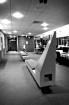
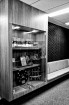
In between is a meeting space. It is a void formed by the mass of brick underfoot and the mass of timber overhead. Two columns, each of four back-to-back mild steel angles and painted black, imply cardinal points. A third column is implied by an expressed copper downpipe. The space between the angles are used to guide a cleverly detailed pair of steel-framed glazed panels. Each panel is counter weighted and smoothly descends – the side of the frames hidden in the columns, the top of the frames sitting flush with the plinth. In the up position, only the gleam of the glass is visible. In the down position, the two black lines in no way suggest their delightful purpose. The inventive resolution of detail imparts a sense of mystery.
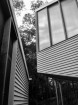
Timber is one of the most ancient of building materials. Its organic nature, the personalities of the different species, and now the politics of selection, demand due diligence. The studio space located on the upper level, is a piece of carefully worked joinery wrapping a hole. The joinery continues the architect’s search for the limits of spotted gum. The shot-edge decking is oiled ironbark. A waterproof membrane under-drains water to the edge. Around the top of the hole, a dexterous ‘H’ pelmet guides a waterproof canvas curtain underneath. On top, it contains the planter bed for a Fraser Island creeper, which has shaped an arbour above the stair. To the outside of the joinery openings, toughened glass panels, covered in film are fixed to stainless-steel ‘spider’ frames. These are mechanically controlled and deflect water and reduce heat in line with the conditions. The experimental nature between the material and purpose belies the architect’s pursuit of new ideas.
This project is a miniature of the city.
