












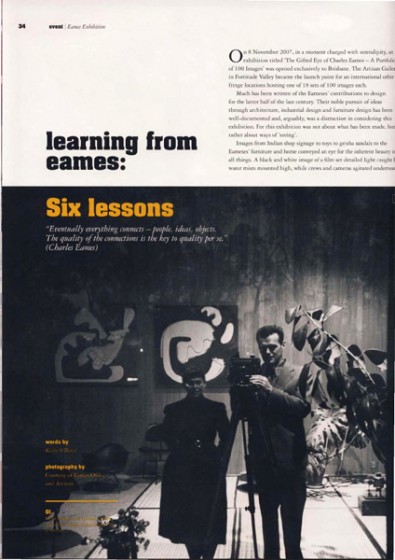
Learning from Eames: Six Lessons
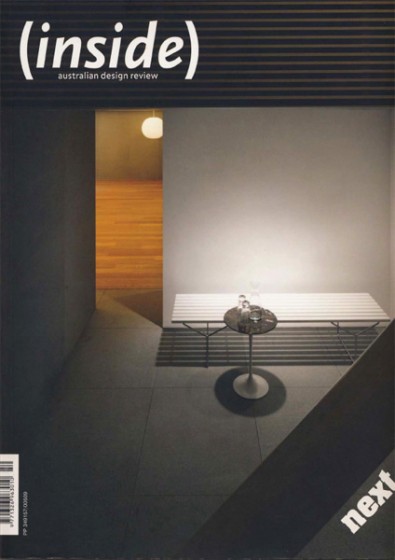
(inside), Issue 50
March, 2008
Curator: Eames Demetrios
Written: Kevin O'Brien
“Eventually everything connects—people, ideas, objects. The quality of the connections is the key toquality per se.” (Charles Eames)
On 8 November, 2007, in a moment charged with serendipity, an Exhibition titled ‘The Gifted Eye of Charles Eames—A Portfolio of 100 images’ was opened exclusively to Brisbane. The Artisan Gallery in Fortitude Valley became the launch point for an international orbit of Fringe locations hosting one of 18 sets of 100 images each.
Much has been written of the Eames's contributions to design for the later half of the last century. Their noble pursuit of Ideas through architecture, industrial design and furniture design is well documented, and arguably, a distraction in considering this Exhibition. For this Exhibition is not about what has been made but rather about ways of Seeing.
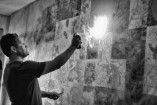
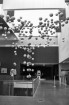
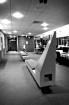
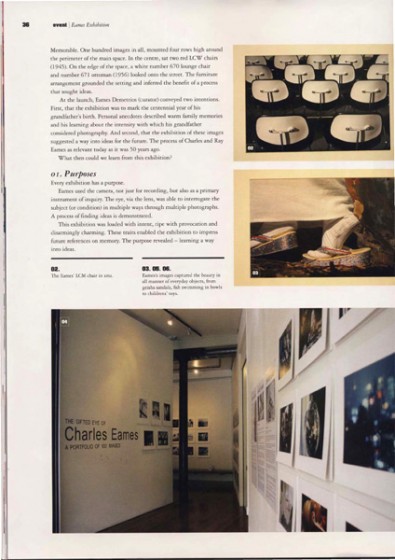
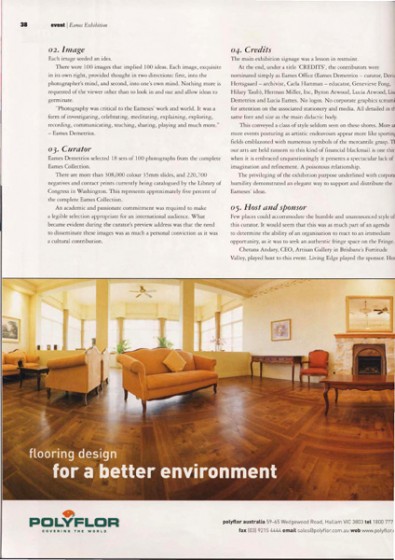
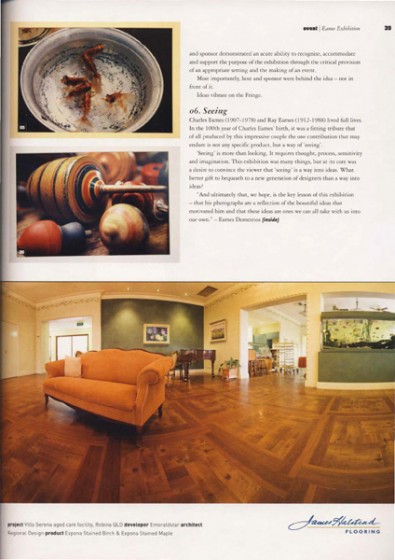
Images from Indian shop signage to toys to geisha sandals to the Eames’s furniture and home convey an Eye for the inherent beauty in all things. A black and white Image of a film set details light caught by water mists mounted high, while crews and cameras agitate underneath. Memorable. 100 images in all, mounted 4 rows high around the perimeter of the main space. In the centre, two red LCW chairs (1945) sat. On the edge of the space, a white no.670 lounge chair and no.671 ottoman (1956) looked onto the street. The furniture arrangement grounded the Setting and inferred the benefit of a process that sought Ideas.
At the launch, Eames Demetrios (curator) conveyed two intentions. Firstly, that the Exhibition was to mark the centennial year of his grandfather. Personal anecdotes described warm family memories and his learning about the intensity with which his grandfather considered photography. And secondly, that the Exhibition of these Images suggest a way into Ideas for the future. The process of Charles and Ray Eames as relevant today as it was 50 years ago.
What then might we learn from this Exhibition?
'01 Purpose'
Every Exhibition has a Purpose.
Eames used the camera, not just for recording, but also as a primary instrument of enquiry. The Eye, via the lens, was able to interrogate the subject (or condition) in multiple ways through multiple photographs.
A process of finding Ideas demonstrated.
This Exhibition was loaded with intent, ripe with provocation and disarmingly charming. These traits enabled the Exhibition to impress future references upon memory. The Purpose revealed—Learning a way into Ideas.
'02 Image'
Each Image seeded an Idea.
100 Images implied 100 Ideas. Each Image, exquisite in its own right, provided thought in two directions; firstly, into the photographer’s mind, and secondly, into one’s own mind. Nothing more is requested of the Viewer other than to look in and out and allow Ideas to germinate.
“Photography was critical to the Eameses’ work and world. It was a form of investigating, celebrating, meditating, explaining, exploring, recording, communicating, teaching, sharing, playing, and much more.” (Eames Demetrios)
'03 Curator'
Eames Demetrios selected 18 sets of 100 photographs out of the Eames Collection.
There are over 308,000 colour 35mm slides, and 220,700 negatives and contact prints currently being catalogued by the Library of Congress in Washington. This represents approximately 5% of the complete Eames Collection.
An academic and passionate commitment was required to make a legible selection appropriate for an international audience. What became evident during the Curator’s preview address was that the need to disseminate these Images was as much a personal conviction as it was a cultural contribution.
'04 Credits'
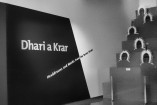
The main Exhibition signage was a lesson in restraint.
At the end, under a title ‘CREDITS’, it nominated the contributors simply as Eames Office (Eames Demetrios, curator, David Hertsgaard, archivist, Carla Hartman, educator, Genevieve Fong, Hilary Taub), Herman Miller, Inc., Byron Atwood, Lucia Atwood, Lisa Demetrios and Lucia Eames. No logos. No corporate graphics screaming for attention on the associated stationary and media. All detailed in the same font and size as the main didactic body.
This conveyed a class of style seldom seen on these shores. More and more Exhibitions posturing an artistic endeavour appear more like sporting fields emblazoned with numerous symbols of the mercantile grasp. That our arts are held ransom to this kind of financial blackmail is one thing, when it is embraced unquestioningly it presents a spectacular lack of imagination and refinement.
The privileging of the Exhibition Purpose married with corporate humility demonstrated an elegant way to support and distribute the Eameses’ Ideas.
'05 Host and Sponsor'
Few places could accommodate the humble and unannounced style of this Curator. It would seem that this was as much part of his agenda to determine the ability of an organization to react to an immediate opportunity, as it was to seek an authentic Fringe space.
Ideas vibrate on the Fringe.
Chetana Andari, CEO, Artisan Gallery in Brisbane’s Fortitude Valley played Host to this event. Living Edge the generous Sponsor. Host and Sponsor demonstrated an acute ability to recognise, accommodate and support the Purpose of the Exhibition through the critical provision of an appropriate Setting and the making of an Event.
Most importantly, Host & Sponsor were behind the Idea—not in front of it.
'06 Seeing'
Charles Eames (1907–1978) and Ray Eames (1912–1988) lived full lives. In this, the 100th year of Charles Eames’ birth, it is a fitting tribute that of all produced by this impressive couple the one contribution that might endure is not any specific product but a way of Seeing.
Seeing is more than looking. It requires thought, process, sensitivity and imagination. This Exhibition is many things but at its core is a desire to convince the Viewer that Seeing is a way into Ideas. What better gift to bequeath to a new generation of designers than a way into Ideas?
“And ultimately that, we hope, is the key lesson of this exhibition—that his photographs are a reflection of the beautiful ideas that motivated him and that these ideas are ones we can all take with us into our own lives.” (Eames Demetrios)
End.
