









Lethbridge House: Hole in the Grid
Architectural Review, Issue 098
September, 2006
Architect: tUG workshop
Written: Kevin O'Brien
One block then right, four blocks ahead and then turn left, one block down to right, the house is at the end. This is my first experience, that which determines the greater attitude to landscape and affords a glimpse of the culture that this project is woven into. Oops, I crossed the road diagonally and suddenly foregrounds and mid-grounds and backgrounds triangulate and dance in front of me. Should I recross the road just to keep in the spirit of this territorial grid that claims the land and better yet organises Melbourne’s social structure? My Indigenous spirit says no and my Irish genes scream an even louder and obscene objection. Okay, I’ll keep walking and hopefully find this house.
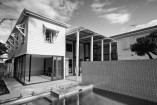
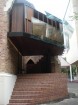
I criss-cross my way up the street as it really is much more interesting. Already I have encountered a few people, friendly and at ease, but I clutch my side bag to be safe. As I arrive at the dead end I am offered a table dripping with spent candles and red wine stains. Nothing dead about this end. The table is virtually on the footpath and presents an invitation to sit down and have a chat, maybe even an argument, or just a beer with political revision. I think I have just been welcomed onto this site. This reminds me of being home on the island where there are no shortages of tables to sit in front of my families’ houses and while away the time in gossip, catch up with the returning cousin or just tell a story. No fence or thorny rose bush to navigate. Maybe the owner hasn’t yet built his defence to keep out the extended family or greater public. The angled pergola structure flies over my head and the table, grating against my momentarily and recently encountered appreciation of the street grid.
Who thought up these grids anyway and what do they have to do with any aspect of Australia’s landscape? Perhaps Hoddle was trying to defend something or simply anticipated how to position a latrine relative to a state boundary line, a local sewer line and a supply line. This linear consideration is short lived as I walk up to where the front door should be. As there is no door handle, or door for that matter, I move to my left searching for something to rattle that will announce my presence to the inhabitants. As I do so I find myself in front of a full height sliding glass panel holding a Marcel Marceau pose with a dark haired girl peering back at me from the inside. She is framed by an opening behind her that again frames something beyond which then seems to be sliced revealing a tree trunk glistening with afternoon light. Light, shade, light shade…
‘What are you doing?’ she demands.
‘I am Kevin and I er .. have an appointment with Gerard here at 4pm’.
‘D-A-D! THERE IS A GUY CALLED KEVIN AT THE FRONT DOOR’.
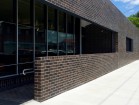
This is the front door? I feel like I am already well into the house refreshingly avoiding the usual need to genuflect at a fussy Scarpa like threshold. This is very unusual, nothing like the neat houses I have walked squarely past, with fences, hedges and blue security lights that defend the inhabitants and protect them from any public exchanges. The suburb inoculates the individual against the community.
Gerard approaches me with a smile, a twinkling eye and an extended right hand.
‘Hello, nice to meet you, come in’.
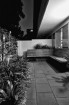
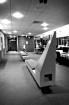
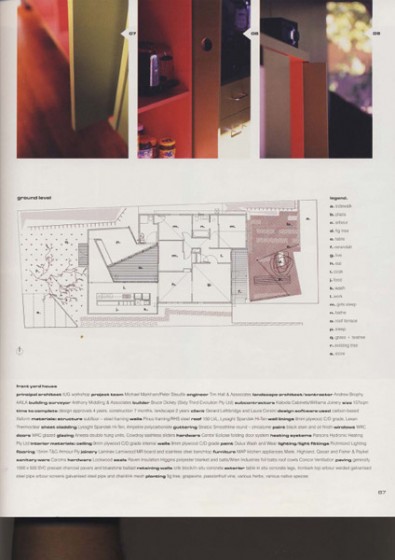
We shake hands and move directly through the original ‘living’ room (the place where marketers allegedly ‘live’), past a formal dining space (where you ‘formally dine’) before taking a seat in the sky room (where the sky is the ceiling). All the while the signs of actually being lived in are on display—not hidden and sanitised as most architectural photographs would imply. A few shirts here, a couple of dishes there, a line of dust here and a couple of casually swinging central desert paintings over there. We sit down in this space and exchange pleasantries about Essendon’s demise, Joh’s Queensland tenure and the Labor parties overdue reinvention (Tony Blair style) while kissing a light beer to grease the conversation. My Irish genes feel comfortable. Actually so do my Indigenous ones as the sky room’s edges frame the plane tree’s canopy and rays of afternoon sun warm us up.
Mm, where is the fire, the thing once cross-culturally embraced? My camp associations understand a central ground protected, ringed by shelter and windbreaks, at the centre of which is a fire. A fire for cooking, signalling and warming. Oh yes, here it is. The fire (that thing Australian insurance companies are afraid of) isn’t downgraded, it is upgraded to receive the sun. The sun charges into the sky room and pours into the interiors, bringing with it its warmth and suggestions of intimate occupations. It now feel’s more like a campsite than a house. I have been repositioned in a tree relative to a sky-scape, not in a suburb with a grid and tidy gabled brick houses in neat rows.
The conversation moves onto much more interesting topics about architecture, politics and religion, world oil prices, marriage and the Australian psyche (Germaine Greer style). This has been an action packed 20 minutes or so. We then speak of the house and the extension and move through into the reorganised original house. Oh, that’s why there is no front door, it is now a study. The formal grid and axis has been denied (surely that would incur the wrath of the people’s municipal council); this wouldn’t seem in keeping with the community (who and what ever that is). Turning into the rear bedroom space a solitary horizontal slot frames a reclined view from the adjacent bunk into the sky room and through to the green canopy. Light, shade, light, shade … a dreaming place.
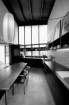
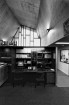
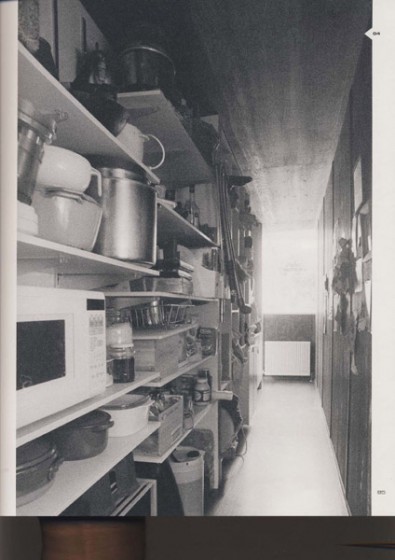
We return to the ‘extension’ and I quickly realise that the sky room really is doing great work that keeps Gerard in high spirits. It has the feel of being at the beach or on holiday, or some other place that people go once a year to escape the grind stone of work and commune with nature, wearing skimpy bathers and being satisfied with the unrefined, when kids stay up late and do what they like, and for that matter, so to do the parents. Not unlike what Aboriginal people have been doing for an eternity—presumably even on this actual site. We move past the kitchen cabinetry, functional and in keeping with the implied grid of the area, then things take a turn for the better. I find myself in front of a window that can be best described as a slice into the skin both revealing a larger glimpse into the garden and activating a dynamic play of skew walls to my right. Gerard and I look into the garden and he recounts a lengthy battle with his daughters to reinstate the trampoline that the childless landscape architect abhorred.
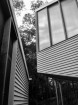
Next stop is the bedroom. The garden expanse is replaced with a narrowing and introverted vista towards a point where the skewed planes of walls, roof and floor meet. An intense threshold with a full height swinging panel turns us into the bedroom. This sequence reminds me of entering a cave (or ascending into an attic if you’re a French philosopher), except we haven’t; we have been compressed in darkness and turned into a light filled room. This is a sleeping space that continues the skewed language. This is not a Cartesian space, it is loose and free of that attempting to hold it hostage. This is a most incongruent space and experience. Now I am awake. The eerie shimmering of light from the ribbed polycarbonate skin that faces the sky room conveys a sense of sleepiness, like the moment when you’re not really awake or asleep but things seem crisp. Dreamtime.
With the honesty of the materials comes a presumed roughness, yet it isn’t rough—it is carefully detailed, even when the angled downpipes trick you into thinking they might be a structural truss. A laugh at my expense? I think it is more likely an invitation to sit down and think about things. After all, ‘thinking’ is also ritual that needs a setting. Talk about all things and understand the virtue of never being compromised. There is even a sense of the parochial and unapologetic, say where the ceiling slams into the connecting doorway from the dining space. This home embodies a synergy between, the family, the architect and an Australian sense of ‘place’.
Something has just become clear though, it would seem that this is the domain of Gerard and the front of the house belongs to the women of the house. This seems to be a clear reflection of the custodians, sorry, I mean owners’ personalities rendered architecturally. As the conversation develops and a story is revealed, a series of comfortable tensions are becoming apparent, men’s business at the back and women’s business at the front, unconventional at the back and conventional at the front (except for the missing picket fence and rose bed), flat roof at the back and gable roof at the front, skew at the back and grid everywhere else—all held together by the sky room. The sky room is the space that connects the spirit to the sky, the sun, the moon and the stars, and is guarded by the inhabitants of the plane tree. This place radiates its presence into those spaces that touch it and are affected by its transfer of a pure sense of spirit. The entire home is guarding this spirit. No, maybe it is the other way around—this place has a spirit that guards it. When there is no spirit there is no life, if there is no life there is nothing.
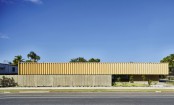
It is odd that this project is referred to as an alteration and addition. Really, it is a completion, in that it makes the existing box (and grid language) that was imposed on this landscape, take on some manners and acknowledge the larger sense of place that it is part of. In Victoria (or any other state for that matter) this is a most impressively genuine architectural response. It is not one that is secretly borrowed or plagiarised (ie ‘stolen’) but one that shines a gleaming mirror towards the Medusa’s scurrying around Batman’s laneways. This site has approached the idea of occupation slightly differently. It denies the usual central-mass-occupying-the-maximum-sitefootprint-type diagram. The middle of the mass is removed to reveal something hidden. It repositions its inhabitants relative to a landscape condition—just like a camp. This is an idea that could be applied at an urban—or should I say—multiple camp scale. Put simply, remove unnecessary fabric, reveal spiritual places and imbue a complete sense of Australian ‘culture’ with ethics about place and history. This celebrates the forgotten, or better yet, the denied. Here, the sky room is the mechanism doing precisely that, it reveals one of the genuine experiences of being in ‘country’ and therefore sustains the spirit. It would seem I have stumbled into something that affected my spirit and will therefore remain in my memory. Maybe these people have a connection to this place that isn’t European, maybe it is truly Australian in that it transcends the colonial history of denial and grounds itself in this place and therefore in a light filled truth.
The End.
