

























Debe Yama / Finding Dignity: 7 Prompts
RAIA National Indigenous Housing Conference, Alice Springs
September, 2007
Written: Kevin O'Brien
An Architecture of Dignity expects that the Inhabitant, together with its Architect, be considered integral and binding to its Idea. The Proposition is that if the Idea is Dignified, the Architecture will follow.
‘Every form of government, every social institution, every undertaking, however great, however small, every symbol of enlightenment or degradation, each and all have sprung and are still springing from the life of the people, and have ever formed and are now as surely forming images of their thought. Slowly by centuries, generations, years, days, hours, the thought of the people has changed; so with the precision have their acts responsively changed; thus thoughts and acts have flowed and are flowing ever onward, unceasingly onward, involved within the impelling power of Life. Throughout this stream of human life, and thought, and activity, men have ever felt the need to build; and from the need arose the power to build. So, as they thought, they built; for, strange as it may seem, they could build in no other way. As they built, they made, used, and left behind them records of their thinking. Then, as through the years new men came with changed thoughts, so arose new buildings in consonance with the change of thought – the building always the expression of the thinking. Whatever the character of the thinking, just so was the character of the building.’ Louis Sullivan(1).
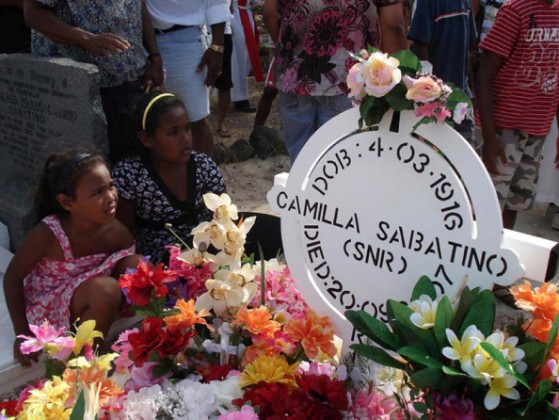
Camilla
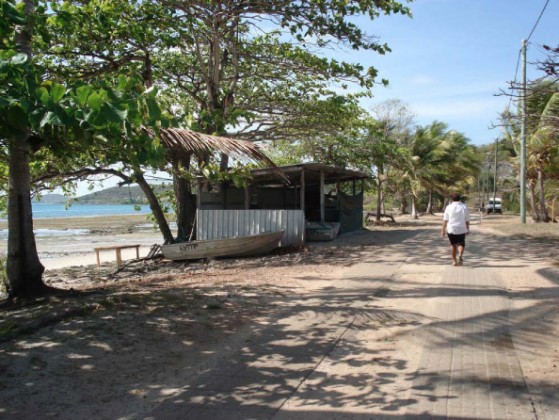
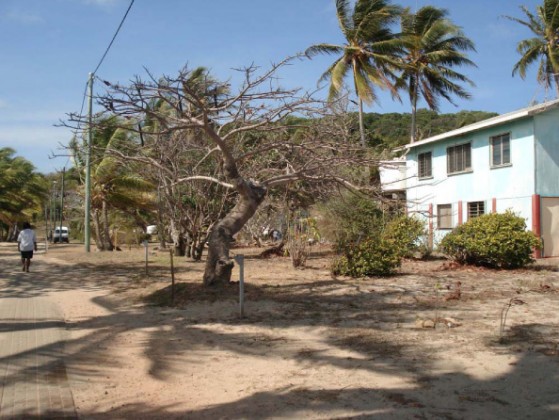
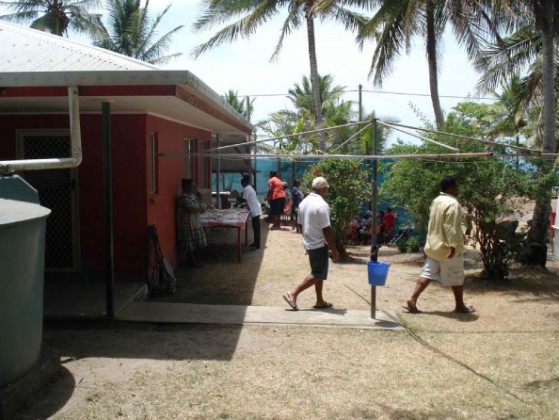
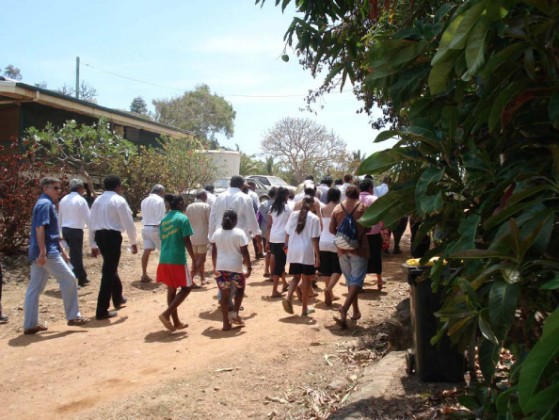
During the past 35 years, I have maintained a conversation with an Elder in far north Queensland. A descendent of the Meriam people, Camilla Sabatino has lived on Keriri (Hammond Island) in the Western Torres Strait Islands for much of her life. Born in 1916 on Nepean Island in the Eastern Torres Strait islands, her 92 years has witnessed the impact of missionaries, Aboriginal Protectors, World War II, white Australia policy, emancipation in 1967(2), and finally, Economic Rationalism; a supposed contest of Ideas for her perceived benefit.
Homelessness, displacement, incarceration, low income, alcohol, minimal education and premature death, have enabled a history of Paternalism. Paternalism assured through a history of land tenure exclusion. Despite this historical construct of Despair up here on the Fringe, Camilla provided hope to all who came into contact with her through one potent resolve; that of Dignity.
During the past 40 years, Camilla experienced a true Public Housing system, all be it with government as the ‘Reluctant Landlords’(3). Shackled economic and social movement have combined to breed a form of passive welfare that has promoted ‘inter‐generational dependency and passivity’(4). The Idea of Home Ownership, until recently(5), denied.
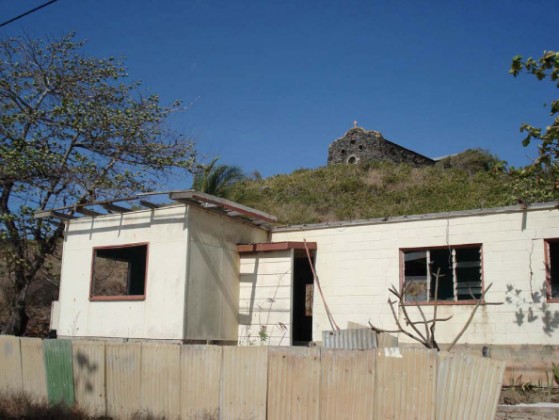
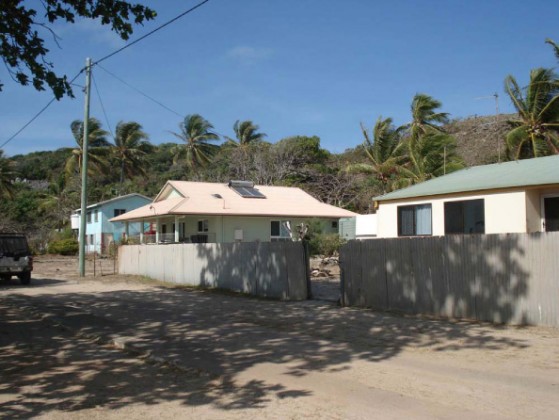
Housing, on that Island, reflects that history.
Australia
On the mainland, Housing as an Idea, was one historically (and continues to be) positioned squarely upon the intersection of Supply and Cost. It followed that the desire of Ownership has dominated Australian housing policy for the past century. It has been argued that there was a Golden Era between 1945 and 1956 when a national housing policy was formulated in direct response to the socio‐economic conditions surrounding World War II. It resulted in the construction of a significant public housing stock. However, the subsequent sale of this stock by successive Commonwealth and State governments may reconsider that period more as a ‘partial exception to this general trend’6 of Ownership.
Of particular note was the establishment of the Commonwealth and States Housing Agreement (CSHA) in 1945. It endures today, with the Commonwealth providing funding to the States to build and manage housing7; a neat division of labour. During the past 30 years there has been a move away from Keynesian economics (government intervention) towards Economic Rationalism (free market place). This has intensified each State’s resolve to maintain the pursuit of cheap housing alongside the User‐pays approach to Home Ownership.
Implicit to this equation was a collateral damage that all but excluded low income earners, the disenfranchised, and the homeless. In fact, the Commission ‘recommended that support should be targeted to those on modest incomes.’8 A vacuum of Paternalism was established for those on the Fringe. Indicative of this attitude, ‘In Victoria, tenants had to commit themselves to maintaining their dwellings in a good state of repair, and not to allow their houses to be used for ‘illegal or immoral purposes’9 together with housing authorities who could visit at any time and ‘offer advice that would address improper behaviour’10. Underwriting this position was the expectation that the government’s desire for the upward socio‐economic movement of its tenants entailed that the housing was of a not too comfortable nature.
Housing on this big Island, reflects that history.
The Argument
Camilla and Australia’s housing experiences are entwined here. Paternalism is the undignified Idea that binds each to the other; even more so for those on the Fringe. It is possible to argue a process that subscribes to an Architecture of Paternalism has emerged and is currently active.
Camilla saw the inductions and erasures of Indigenous entities such as Aboriginal Housing Associations (AHA), the Aboriginal and Torres Strait Islander Commission (ATSIC), and Aboriginal Housing Boards (AHB). Camilla has also seen a number of Government programs continue to limp on like the National Aboriginal Health Strategy (NAHS), Aboriginal Rental Housing Program (ARHP), Community Housing and Infrastructure Program (CHIP) and most recently a policy framework for both levels of government titled ‘Building a Better Future – Indigenous Housing to 2010 (BBF)’(11).
But Australia has the CSHA. Since 1945 it has maintained a division of labour in housing and policy between Commonwealth and State governments from both sides of politics. Since 1945, the CSHA has struggled to allow successive governments any real mechanism to rectify the socio‐economic state of housing across the country. It could be further argued that there is an inherent history of Paternalism embedded within the Idea of the CSHA which prevents genuine attempts to move forward. Comparatively speaking, it is not unreasonable to expect it too might be erased.
And if it were, and in the Spirit of Working Together, what if we were to stop and look around for other ways forward? A preliminary, but by no means exhaustive, desktop enquiry into practices from around the world suggested the following 7 Prompts for Indigenous Housing.
#1 A National Housing Agency
“Canada Mortgage and Housing Corporation (CMHC) is Canada’s national housing agency. Established as a government‐owned corporation in 1946 to address Canada’s post‐war housing shortage, the agency has grown into a major national institution. CMHC is Canada’s premier provider of mortgage loan insurance, mortgage backed securities, housing policy and programs, and housing research.” Canada(12).
A number of countries have national housing agencies. The debate as to how successful a model it is relative to the Australian condition is the debate. It may be useful to consider a National Housing Agency as a focused entity in providing a way forward.
#2 A Comprehensive Policy
“Housing policy alone cannot guarantee desirable housing. Monetary, labour market, transport, social assistance and planning policies all have the potential to exercise as much, and sometimes more, influence on housing outcomes.” New Zealand(13).
“General welfare support remains low. However, the increase in homelessness, along with indicators such as bankruptcy, job‐hopping, and domestic violence, mentioned earlier, suggests that broader social welfare policies are needed.” Japan(14).
A number of countries have comprehensive housing policies that are arrived at through a broader consideration of both the social and economic constraints of simply making a cheap house. It may be useful to consider a Comprehensive Policy in providing a way forward.
#3 The Citizen
"Our policy is to give every Singaporean a stake in the country. We want everyone to own a piece of Singapore, to feel a sense of ownership of the country, and to have a long‐term commitment to the nation... There is no better stake in the country than a flat or a house." Singapore(15).
“Everyone should have the opportunity to rent or buy a decent home at a price they can afford, in a place where they want to live and work.” United Kingdom(16).
A number of countries maintain clear expectations and rights of and for its citizens. Implicit to this condition is an understanding of a relationship between the citizen and its nation. It may be useful to consider the expectations and rights of the Citizen, rather than that of just a tenant, in providing a way forward.
#4 Partnerships
“Måori have compelling cultural, social, Treaty and economic reasons to address the housing needs of whånau, hapü and iwi. They require access to government programmes that are responsive to iwi and Māori priorities and aspirations. As a Crown entity, Housing New Zealand Corporation must develop strategies and processes to meet this growing challenge.” New Zealand(17).
A number of countries contain Indigenous populations. The difference lies in the attitudes and Ideas of equality that are extended to the original inhabitants from subsequent populations. It is a complex condition, one largely considered mutually exclusive on most continents. It may be useful to consider a Partnership between governments and Indigenous people, as equals, in providing a way forward.
#5 Multiple Tenures
“There are three different forms of tenure: ownership, tenant‐ ownership and rental. Forty‐six per cent of all dwellings are single or two‐family houses, usually owner‐occupied. Just under 40% are rented dwellings, while 15% are tenant‐owned…Tenant‐ownership involves membership in a non‐profit association whose task is to provide its members with dwellings...” Sweden(18).
A number of countries allow multiple forms of tenure. This fundamental access to choice could be argued a democratic right. It could be further argued that a single form of tenure denies diversity. It may be useful to consider access to Multiple Tenures in providing a way forward.
#6 Identity
“Good design is crucial in creating places where people are proud to live.” United Kingdom(19).
“To build living environments that residents can readily identify with, towns and neighbourhoods incorporate design themes that reflect the heritage or personality of the area…with supporting social and recreational facilities to help heighten residents' sense of belonging.” Singapore(20).
A number of countries understand the importance of design. This is an argument not just for the involvement of architects but rather, for a way of thinking for all consultants involved in the consideration of Indigenous housing. It could be argued that a properly resourced Government Architect Office is the mechanism to lead this argument for Design. It may be useful to consider the role of Design in providing a way forward.
#7 Peer Review
“I would like to pick one example on a forum for mutual learning from the work on homelessness. That is Peer Review as I mentioned before. Peer Review is arranged by the European Commission as a part of the program on social inclusion. Peer Review is a mutual learning place based on systematic evaluation of a good example.” Norway(21)
A number of countries anticipate the organic nature of housing and submit to the scholarly convention of Peer Review. Access to other successes and failures is a critical process to subscribe to. It could be argued that a Pacific Rim group would provide a reasonable level of cultural difference and similarities but most importantly foster comparative studies. It may be useful to consider a process of Peer Review in providing a way forward.
These are the Prompts for an Idea of Dignity. Now, imagine its Architecture.
End.
(1) From ‘What is Architecture? A Study in the American People of Today’ by Louis Sullivan quoted in ‘Architecture and Democracy’ by Claude Fayette Bragdon at http://www.gutenberg.org/files/12625/12625‐8.txt viewed 2 October, 2007
(2) 1967 Referendum recognized Aboriginal people as Australian citizens. See 1967 Bill at http://www.aph.gov.au/Library/Pubs/bp/1996‐97/97bp11.htm#1967 viewed 1 October, 2007
(3) David Hayward, ‘The Reluctant Landlords? A History of Public Housing In Australia’ at www.infoxchange.net.au/rhchome/iurhc/s01.htm viewed 2 October, 2007
(4) ‘Position on Land and Housing’ at http://www.cyi.org.au/landhousing.aspx viewed 1 October, 2007
(5) Noel Pearson, ‘Housing in Cape York: The Role of Private Home Ownership’ at http://www.cyi.org.au/feb2007.aspx viewed 1 October, 2007
(6) David Hayward, ‘The Reluctant Landlords? A History of Public Housing In Australia’ at www.infoxchange.net.au/rhchome/iurhc/s01.htm viewed 2 October, 2007
(7) Commonwealth and States Housing Agreement at
http://www.facsia.gov.au/Internet/facsinternet.nsf/aboutfacs/programs/house‐csha.htm viewed 2 October, 2007
(8) David Hayward, ‘The Reluctant Landlords? A History of Public Housing In Australia’ at www.infoxchange.net.au/rhchome/iurhc/s01.htm viewed 2 October, 2007
(9) Quoted in Howe, 1988b: 54 by David Hayward, ‘The Reluctant Landlords? A History of Public Housing In Australia’
at www.infoxchange.net.au/rhchome/iurhc/s01.htm viewed 2 October, 2007
(10) Howe, 1988b; Marsden, 1986 by David Hayward, ‘The Reluctant Landlords? A History of Public Housing In
Australia’ at www.infoxchange.net.au/rhchome/iurhc/s01.htm viewed 2 October, 2007
(11) At http://www.facs.gov.au/internet/facsinternet.nsf/aboutfacs/programs/community‐indig_housing_2010.htm viewed 2 October, 2007.
(12) At http://www.cmhc.ca/en/corp/about/index.cfm?renderforprint=1 viewed 2 October, 2007.
(13) Helen Fulcher in Housing New Zealand Corporation, ‘Building the Future: The New Zealand Housing Strategy’ at
http://www.hnzc.co.nz/hnzc/web/research‐&‐policy/policy‐&‐strategy/new‐zealand‐housing‐strategy/newzealand‐
housing‐strategy_home.htm viewed 5 October, 2007.
(14) Yoshihiro Okamoto, ‘A Comparative Study of Homelessness in the United Kingdom and Japan,” Journal of Social
Issues, Vol. 63, No. 3, (2007): p.538.
(15) Prime Minister Goh Chok Tong, Aug 1995, Government of Singapore, ‘Building Homes, Shaping Communities’ at
http://www.mnd.gov.sg/handbook/build_main.htm viewed 5 October, 2007.
(16) Government of the United Kingdom, ‘About Housing’ at http://www.communities.gov.uk/housing/about viewed
2 October, 2007.
(17) Housing New Zealand Corporation, ‘Te Au Roa: Into the Future’ at http://www.hnzc.co.nz/hnzc/web/aboutus/
our‐publications/maori‐strategic‐plan.htm viewed 5 October, 2007.
(18) The Swedish Institute, ‘Sweden: Housing and Housing Policy’ at
http://action.web.ca/home/housing/resources.shtml viewed 2 October, 2007.
(19) Government of the United Kingdom, ‘About Housing’ at http://www.communities.gov.uk/housing/about viewed
2 October, 2007.
(20) Government of Singapore, ‘Building Homes, Shaping Communities’ at
http://www.mnd.gov.sg/handbook/build_main.htm viewed 5 October, 2007.
(21) Guri Storvold, 2006, ‘Norwegian Housing Policy – Learning from European experiences’ at
http://www.regjeringen.no/en/dep/krd/min/Other‐political‐staff/avskjedigete/Secretary‐of‐State‐Guri‐
Storvold/taler_artikler/2006/Norwegian‐Housing‐policy‐learning‐from‐E.html?id=437244 viewed at 2 October,
2007.
